> For the complete documentation index, see [llms.txt](https://leetcode-solution-leetcode-pp.gitbook.io/leetcode-solution/llms.txt). Markdown versions of documentation pages are available by appending `.md` to page URLs; this page is available as [Markdown](https://leetcode-solution-leetcode-pp.gitbook.io/leetcode-solution/medium/912.sort-an-array.md).
# 0912. 排序数组
### 题目地址(912. 排序数组)
### 题目描述
```
给你一个整数数组 nums,请你将该数组升序排列。
示例 1:
输入:nums = [5,2,3,1]
输出:[1,2,3,5]
示例 2:
输入:nums = [5,1,1,2,0,0]
输出:[0,0,1,1,2,5]
提示:
1 <= nums.length <= 50000
-50000 <= nums[i] <= 50000
```
### 前置知识
* 数组
* 排序
### 公司
* 阿里
* 百度
* 字节
### 思路
这是一个很少见的直接考察`排序`的题目。 其他题目一般都是暗含`排序`,这道题则简单粗暴,直接让你排序。 并且这道题目的难度是`Medium`, 笔者感觉有点不可思议。
我们先来看题目的限制条件,这其实在选择算法的过程中是重要的。 看到这道题的时候,大脑就闪现出了各种排序算法, 这也算是一个复习[`排序算法`](https://www.scaler.com/topics/data-structures/sorting-algorithms/)的机会吧。
题目的限制条件是有两个,第一是元素个数不超过 10k,这个不算大。 另外一个是数组中的每一项范围都是`-50k`到`50k`(包含左右区间)。 看到这里,基本我就排除了时间复杂度为 O(n^2)的算法。
> 我没有试时间复杂度 O(n^2) 的解法,大家可以试一下,看是不是会 TLE。
剩下的就是基于比较的`nlogn`算法,以及基于特定条件的 O(n)算法。
由于平时很少用到`计数排序`等 O(n)的排序算法,一方面是空间复杂度不是常量,另一方面是其要求数据范围不是很大才行,不然会浪费很多空间。 但是这道题我感觉可以试一下。 在这里,我用了两种方法,一种是`计数排序`,一种是`快速排序`来解决。 大家也可以尝试用别的解法来解决。
#### 解法一 - 计数排序
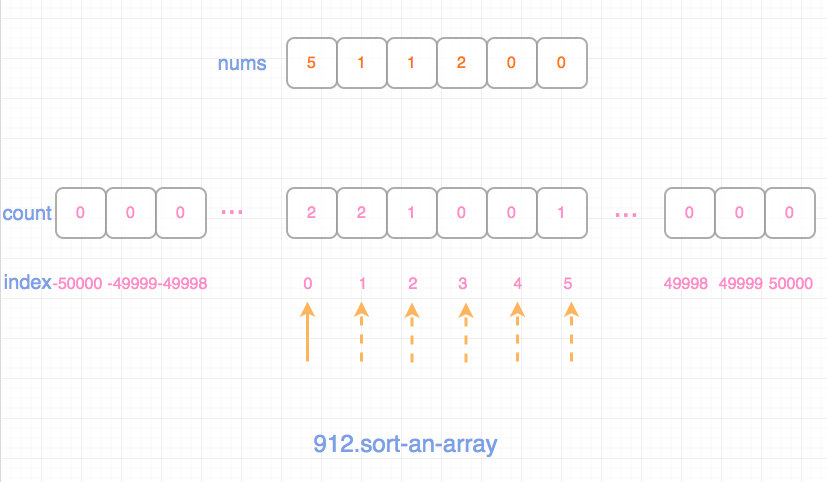
时间复杂度 O(n)空间复杂度 O(m) m 为数组中值的取值范围,在这道题就是`50000 * 2 + 1`。
我们只需要准备一个数组取值范围的数字,然后遍历一遍,将每一个元素放到这个数组对应位置就好了, 放的规则是`索引为数字的值,value为出现的次数`。
这样一次遍历,我们统计出了所有的数字出现的位置和次数。 我们再来一次遍历,将其输出到即可。
#### 解法二 - 快速排序
快速排序和归并排序都是分支思想来进行排序的算法, 并且二者都非常流行。 快速排序的核心点在于选择轴元素。
每次我们将数组分成两部分,一部分是比 pivot(轴元素)大的,另一部分是不比 pivot 大的。 我们不断重复这个过程, 直到问题的规模缩小的寻常(即只有一个元素的情况)。
快排的核心点在于如何选择轴元素,一般而言,选择轴元素有三种策略:
* 数组最左边的元素
* 数组最右边的元素
* 数组中间的元素(我采用的是这种,大家可以尝试下别的)
* 数组随机一项元素

(图片来自: )
> 图片中的轴元素是最后面的元素,而提供的解法是中间元素,这点需要注意,但是这并不影响理解。
### 关键点解析
* 排序算法
* 注意题目的限制条件从而选择合适的算法
### 代码
计数排序:
代码支持: JavaScript
```js
/**
* @param {number[]} nums
* @return {number[]}
*/
var sortArray = function (nums) {
const counts = Array(50000 * 2 + 1).fill(0);
const res = [];
for (const num of nums) counts[50000 + num] += 1;
for (let i in counts) {
while (counts[i]--) {
res.push(i - 50000);
}
}
return res;
};
```
快速排序:
代码支持: JavaScript
```js
function swap(nums, a, b) {
const temp = nums[a];
nums[a] = nums[b];
nums[b] = temp;
}
function helper(nums, start, end) {
if (start >= end) return;
const pivotIndex = start + ((end - start) >>> 1);
const pivot = nums[pivotIndex];
let i = start;
let j = end;
while (i <= j) {
while (nums[i] < pivot) i++;
while (nums[j] > pivot) j--;
if (i <= j) {
swap(nums, i, j);
i++;
j--;
}
}
helper(nums, start, j);
helper(nums, i, end);
}
/**
* @param {number[]} nums
* @return {number[]}
*/
var sortArray = function (nums) {
helper(nums, 0, nums.length - 1);
return nums;
};
```
### 扩展
* 你是否可以用其他方式排序算法解决?
* 你可以使用同样的算法对链表进行排序么?(大家可以用力扣 `148.排序链表` 进行验证哦)
### 参考
* [QuickSort - geeksforgeeks](https://www.geeksforgeeks.org/quick-sort/)