> For the complete documentation index, see [llms.txt](https://leetcode-solution-leetcode-pp.gitbook.io/leetcode-solution/llms.txt). Markdown versions of documentation pages are available by appending `.md` to page URLs; this page is available as [Markdown](https://leetcode-solution-leetcode-pp.gitbook.io/leetcode-solution/easy/155.min-stack.md).
# 0155. 最小栈
## 题目地址(155. 最小栈)
## 题目描述
```
设计一个支持 push ,pop ,top 操作,并能在常数时间内检索到最小元素的栈。
push(x) —— 将元素 x 推入栈中。
pop() —— 删除栈顶的元素。
top() —— 获取栈顶元素。
getMin() —— 检索栈中的最小元素。
示例:
输入:
["MinStack","push","push","push","getMin","pop","top","getMin"]
[[],[-2],[0],[-3],[],[],[],[]]
输出:
[null,null,null,null,-3,null,0,-2]
解释:
MinStack minStack = new MinStack();
minStack.push(-2);
minStack.push(0);
minStack.push(-3);
minStack.getMin(); --> 返回 -3.
minStack.pop();
minStack.top(); --> 返回 0.
minStack.getMin(); --> 返回 -2.
提示:
pop、top 和 getMin 操作总是在 非空栈 上调用。
```
### 前置知识
* [栈](/leetcode-solution/thinkings/basic-data-structure.md)
### 公司
* amazon
* bloomberg
* google
* snapchat
* uber
* zenefits
* 阿里
* 腾讯
* 百度
* 字节
### 两个栈
#### 思路
我们使用两个栈:
* 一个栈存放全部的元素,push,pop都是正常操作这个正常栈。
* 另一个存放最小栈。 每次push,如果比最小栈的栈顶还小,我们就push进最小栈,否则不操作
* 每次pop的时候,我们都判断其是否和最小栈栈顶元素相同,如果相同,那么我们pop掉最小栈的栈顶元素即可
#### 关键点
* 往minstack中 push的判断条件。 应该是stack为空或者x小于等于minstack栈顶元素
#### 代码
* 语言支持:JS,C++,Java,Python
JavaScript Code:
```js
/**
* initialize your data structure here.
*/
var MinStack = function() {
this.stack = []
this.minStack = []
};
/**
* @param {number} x
* @return {void}
*/
MinStack.prototype.push = function(x) {
this.stack.push(x)
if (this.minStack.length == 0 || x <= this.minStack[this.minStack.length - 1]) {
this.minStack.push(x)
}
};
/**
* @return {void}
*/
MinStack.prototype.pop = function() {
const x = this.stack.pop()
if (x !== void 0 && x === this.minStack[this.minStack.length - 1]) {
this.minStack.pop()
}
};
/**
* @return {number}
*/
MinStack.prototype.top = function() {
return this.stack[this.stack.length - 1]
};
/**
* @return {number}
*/
MinStack.prototype.min = function() {
return this.minStack[this.minStack.length - 1]
};
/**
* Your MinStack object will be instantiated and called as such:
* var obj = new MinStack()
* obj.push(x)
* obj.pop()
* var param_3 = obj.top()
* var param_4 = obj.min()
*/
```
C++ Code:
```
class MinStack {
stack data;
stack helper;
public:
/** initialize your data structure here. */
MinStack() {
}
void push(int x) {
data.push(x);
if(helper.empty() || helper.top() >= x)
{
helper.push(x);
}
}
void pop() {
int top = data.top();
data.pop();
if(top == helper.top())
{
helper.pop();
}
}
int top() {
return data.top();
}
int getMin() {
return helper.top();
}
};
/**
* Your MinStack object will be instantiated and called as such:
* MinStack* obj = new MinStack();
* obj->push(x);
* obj->pop();
* int param_3 = obj->top();
* int param_4 = obj->getMin();
*/
```
Java Code:
```java
public class MinStack {
// 数据栈
private Stack data;
// 辅助栈
private Stack helper;
/**
* initialize your data structure here.
*/
public MinStack() {
data = new Stack<>();
helper = new Stack<>();
}
public void push(int x) {
// 辅助栈在必要的时候才增加
data.add(x);
if (helper.isEmpty() || helper.peek() >= x) {
helper.add(x);
}
}
public void pop() {
// 关键 3:data 一定得 pop()
if (!data.isEmpty()) {
// 注意:声明成 int 类型,这里完成了自动拆箱,从 Integer 转成了 int,
// 因此下面的比较可以使用 "==" 运算符
int top = data.pop();
if(top == helper.peek()){
helper.pop();
}
}
}
public int top() {
if(!data.isEmpty()){
return data.peek();
}
}
public int getMin() {
if(!helper.isEmpty()){
return helper.peek();
}
}
}
```
Python3 Code:
```python
class MinStack:
def __init__(self):
"""
initialize your data structure here.
"""
self.stack = []
self.minstack = []
def push(self, x: int) -> None:
self.stack.append(x)
if not self.minstack or x <= self.minstack[-1]:
self.minstack.append(x)
def pop(self) -> None:
tmp = self.stack.pop()
if tmp == self.minstack[-1]:
self.minstack.pop()
def top(self) -> int:
return self.stack[-1]
def min(self) -> int:
return self.minstack[-1]
# Your MinStack object will be instantiated and called as such:
# obj = MinStack()
# obj.push(x)
# obj.pop()
# param_3 = obj.top()
# param_4 = obj.min()
```
**复杂度分析**
* 时间复杂度:O(1)
* 空间复杂度:O(1)
### 一个栈
#### 思路
符合直觉的方法是,每次对栈进行修改操作(push和pop)的时候更新最小值。 然后getMin只需要返回我们计算的最小值即可, top也是直接返回栈顶元素即可。 这种做法每次修改栈都需要更新最小值,因此时间复杂度是O(n).
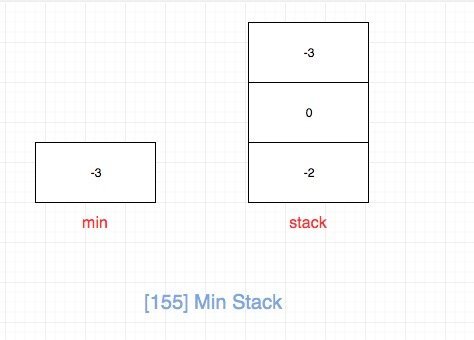
是否有更高效的算法呢?答案是有的。
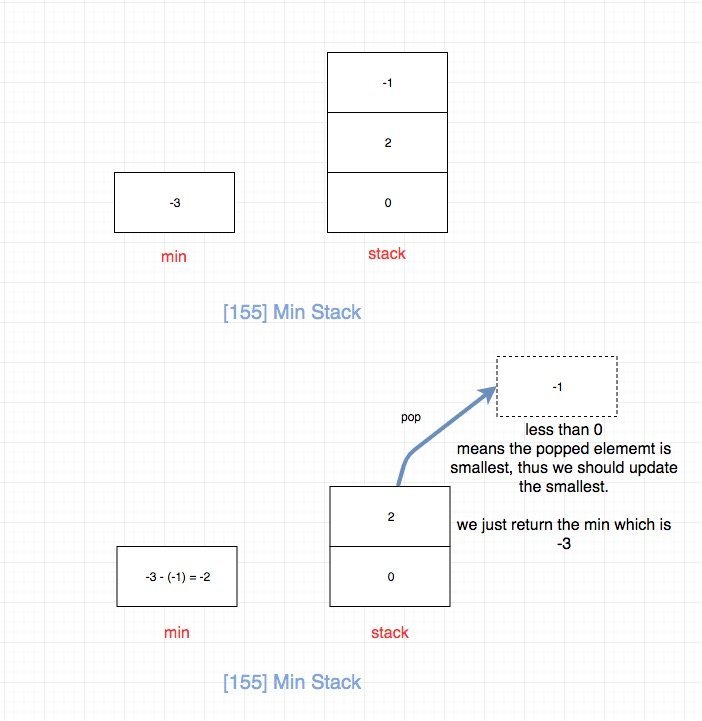
我们每次入栈的时候,保存的不再是真正的数字,而是它与当前最小值的差(当前元素没有入栈的时候的最小值)。 这样我们pop和top的时候拿到栈顶元素再加上**上一个**最小值即可。 另外我们在push和pop的时候去更新min,这样getMin的时候就简单了,直接返回min。
> 注意上面加粗的“上一个”,不是“当前的最小值”
经过上面的分析,问题的关键转化为“如何求得上一个最小值”,解决这个的关键点在于利用min。
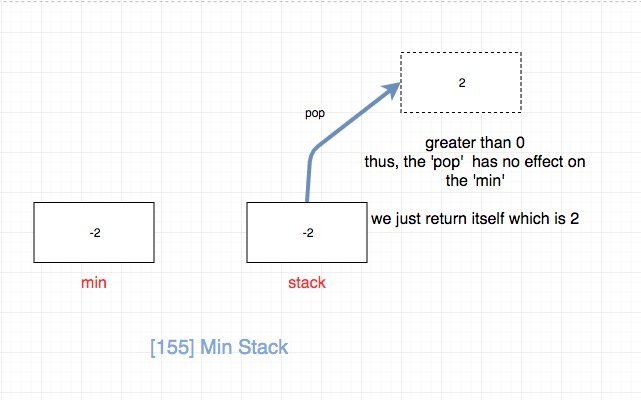
pop或者top的时候:
* 如果栈顶元素小于0,说明栈顶是当前最小的元素,它出栈会对min造成影响,我们需要去更新min。 上一个最小的是“min - 栈顶元素”,我们需要将上一个最小值更新为当前的最小值
> 因为栈顶元素入栈的时候的通过 `栈顶元素 = 真实值 - 上一个最小的元素` 得到的, 而真实值 = min, 因此可以得出`上一个最小的元素 = 真实值 -栈顶元素`
* 如果栈顶元素大于0,说明它对最小值`没有影响`,上一个最小值就是上上个最小值。
#### 关键点
* 最小栈存储的不应该是真实值,而是真实值和min的差值
* top的时候涉及到对数据的还原,这里千万注意是**上一个**最小值
#### 代码
* 语言支持:JS,C++,Java,Python
Javascript Code:
```js
/*
* @lc app=leetcode id=155 lang=javascript
*
* [155] Min Stack
*/
/**
* initialize your data structure here.
*/
var MinStack = function() {
this.stack = [];
this.minV = Number.MAX_VALUE;
};
/**
* @param {number} x
* @return {void}
*/
MinStack.prototype.push = function(x) {
// update 'min'
const minV = this.minV;
if (x < this.minV) {
this.minV = x;
}
return this.stack.push(x - minV);
};
/**
* @return {void}
*/
MinStack.prototype.pop = function() {
const item = this.stack.pop();
const minV = this.minV;
if (item < 0) {
this.minV = minV - item;
return minV;
}
return item + minV;
};
/**
* @return {number}
*/
MinStack.prototype.top = function() {
const item = this.stack[this.stack.length - 1];
const minV = this.minV;
if (item < 0) {
return minV;
}
return item + minV;
};
/**
* @return {number}
*/
MinStack.prototype.min = function() {
return this.minV;
};
/**
* Your MinStack object will be instantiated and called as such:
* var obj = new MinStack()
* obj.push(x)
* obj.pop()
* var param_3 = obj.top()
* var param_4 = obj.min()
*/
```
C++ Code:
```
class MinStack {
stack data;
long min = INT_MAX;
public:
/** initialize your data structure here. */
MinStack() {
}
void push(int x) {
data.push(x - min);
if(x < min)
{
min = x;
}
}
void pop() {
long top = data.top();
data.pop();
// 更新最小值
if(top < 0)
{
min -= top;
}
}
int top() {
long top = data.top();
// 最小值为 min
if (top < 0)
{
return min;
}
else{
return min+top;
}
}
int getMin() {
return min;
}
};
/**
* Your MinStack object will be instantiated and called as such:
* MinStack* obj = new MinStack();
* obj->push(x);
* obj->pop();
* int param_3 = obj->top();
* int param_4 = obj->getMin();
*/
```
Java Code:
```java
class MinStack {
long min;
Stack stack;
/** initialize your data structure here. */
public MinStack() {
stack = new Stack<>();
}
public void push(int x) {
if (stack.isEmpty()) {
stack.push(0L);
min = x;
}
else {
stack.push(x - min);
if (x < min)
min = x;
}
}
public void pop() {
long p = stack.pop();
if (p < 0) {
// if (p < 0), the popped value is the min
// Recall p is added by this statement: stack.push(x - min);
// So, p = x - old_min
// old_min = x - p
// again, if (p < 0), x is the min so:
// old_min = min - p
min = min - p;
}
}
public int top() {
long p = stack.peek();
if (p < 0) {
return (int) min;
}
else {
// p = x - min
// x = p + min
return (int) (p + min);
}
}
public int getMin() {
return (int) min;
}
}
```
Python Code:
```python
class MinStack:
def __init__(self):
"""
initialize your data structure here.
"""
self.minV = float('inf')
self.stack = []
def push(self, x: int) -> None:
self.stack.append(x - self.minV)
if x < self.minV:
self.minV = x
def pop(self) -> None:
if not self.stack:
return
tmp = self.stack.pop()
if tmp < 0:
self.minV -= tmp
def top(self) -> int:
if not self.stack:
return
tmp = self.stack[-1]
if tmp < 0:
return self.minV
else:
return self.minV + tmp
def min(self) -> int:
return self.minV
# Your MinStack object will be instantiated and called as such:
# obj = MinStack()
# obj.push(x)
# obj.pop()
# param_3 = obj.top()
# param_4 = obj.min()
```
**复杂度分析**
* 时间复杂度:O(1)
* 空间复杂度:O(1)
更多题解可以访问我的LeetCode题解仓库: 。 目前已经37K star啦。
关注公众号力扣加加,努力用清晰直白的语言还原解题思路,并且有大量图解,手把手教你识别套路,高效刷题。