> For the complete documentation index, see [llms.txt](https://leetcode-solution-leetcode-pp.gitbook.io/leetcode-solution/llms.txt). Markdown versions of documentation pages are available by appending `.md` to page URLs; this page is available as [Markdown](https://leetcode-solution-leetcode-pp.gitbook.io/leetcode-solution/medium/394.decode-string.md).
# 0394. 字符串解码
### 题目地址(394. 字符串解码)
### 题目描述
```
给定一个经过编码的字符串,返回它解码后的字符串。
编码规则为: k[encoded_string],表示其中方括号内部的 encoded_string 正好重复 k 次。注意 k 保证为正整数。
你可以认为输入字符串总是有效的;输入字符串中没有额外的空格,且输入的方括号总是符合格式要求的。
此外,你可以认为原始数据不包含数字,所有的数字只表示重复的次数 k ,例如不会出现像 3a 或 2[4] 的输入。
示例 1:
输入:s = "3[a]2[bc]"
输出:"aaabcbc"
示例 2:
输入:s = "3[a2[c]]"
输出:"accaccacc"
示例 3:
输入:s = "2[abc]3[cd]ef"
输出:"abcabccdcdcdef"
示例 4:
输入:s = "abc3[cd]xyz"
输出:"abccdcdcdxyz"
```
### 前置知识
* 栈
* 括号匹配
### 使用栈
#### 思路
题目要求将一个经过编码的字符解码并返回解码后的字符串。题目给定的条件是只有四种可能出现的字符
1. 字母
2. 数字
3. \[
4. ]
并且输入的方括号总是满足要求的(成对出现),数字只表示重复次数。
那么根据以上条件,可以看出其括号符合栈先进后出的特性以及递归的特质,稍后我们使用递归来解。
那么现在看一下迭代的解法。
我们可以利用 stack 来实现这个操作,遍历这个字符串 s,判断每一个字符的类型:
* 如果是字母 --> 添加到 stack 当中
* 如果是数字 --> 先不着急添加到 stack 中 --> 因为有可能有多位
* 如果是 \[ --> 说明重复字符串开始 --> 将数字入栈 --> 并且将数字清零
* 如果是 ] --> 说明重复字符串结束 --> 将重复字符串重复前一步储存的数字遍
拿题目给的例子`s = "3[a2[c]]"` 来说:

在遇到 `】` 之前,我们不断执行压栈操作:

当遇到 `】`的时候,说明我们应该出栈了,不断出栈知道对应的`【`,这中间的就是 repeatStr。
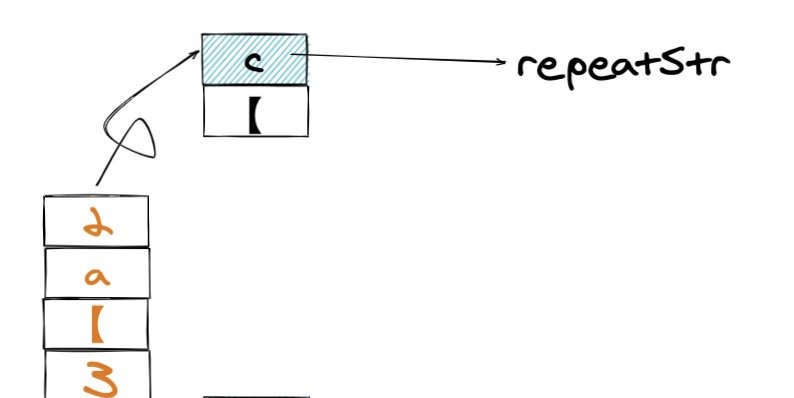
但是要重复几次呢? 我们需要继续出栈,直到非数字为止,这个数字我们记录为 repeatCount。

而最终的字符串就是 repeatCount 个 repeatStr 拼接的形式。 **并将其看成一个字母压入栈中**。

继续,后面的逻辑是一样的:

(最终图)
#### 代码
代码支持:Python
Python:
```py
class Solution:
def decodeString(self, s: str) -> str:
stack = []
for c in s:
if c == ']':
repeatStr = ''
repeatCount = ''
while stack and stack[-1] != '[':
repeatStr = stack.pop() + repeatStr
# pop 掉 "["
stack.pop()
while stack and stack[-1].isnumeric():
repeatCount = stack.pop() + repeatCount
stack.append(repeatStr * int(repeatCount))
else:
stack.append(c)
return "".join(stack)
```
**复杂度分析**
* 时间复杂度:$O(N)$,其中 N 为解码后的 s 的长度。
* 空间复杂度:$O(N)$,其中 N 为解码后的 s 的长度。
### 递归
#### 思路
递归的解法也是类似。由于递归的解法并不比迭代书写简单,以及递归我们将在第三节讲述。
主逻辑仍然和迭代一样。 只不过每次碰到左括号就进入递归,碰到右括号就跳出递归返回即可。
唯一需要注意的是,我这里使用了 start 指针跟踪当前遍历到的位置, 因此如果使用递归需要在递归返回后更新指针。
#### 代码
```py
class Solution:
def decodeString(self, s: str) -> str:
def dfs(start):
repeat_str = repeat_count = ''
while start < len(s):
if s[start].isnumeric():
repeat_count += s[start]
elif s[start] == '[':
# 更新指针
start, t_str = dfs(start + 1)
# repeat_count 仅作用于 t_str,而不作用于当前的 repeat_str
repeat_str = repeat_str + t_str * int(repeat_count)
repeat_count = ''
elif s[start] == ']':
return start, repeat_str
else:
repeat_str += s[start]
start += 1
return repeat_str
return dfs(0)
```
**复杂度分析**
* 时间复杂度:$O(N)$,其中 N 为解码后的 s 的长度。
* 空间复杂度:$O(N)$,其中 N 为解码后的 s 的长度。
更多题解可以访问我的 LeetCode 题解仓库: 。 目前已经 37K star 啦。
大家也可以关注我的公众号《力扣加加》获取更多更新鲜的 LeetCode 题解
