> For the complete documentation index, see [llms.txt](https://leetcode-solution-leetcode-pp.gitbook.io/leetcode-solution/llms.txt). Markdown versions of documentation pages are available by appending `.md` to page URLs; this page is available as [Markdown](https://leetcode-solution-leetcode-pp.gitbook.io/leetcode-solution/easy/1260.shift-2d-grid.md).
# 1260. 二维网格迁移
### 题目地址(1260. 二维网格迁移)
### 题目描述
```
给你一个 n 行 m 列的二维网格 grid 和一个整数 k。你需要将 grid 迁移 k 次。
每次「迁移」操作将会引发下述活动:
位于 grid[i][j] 的元素将会移动到 grid[i][j + 1]。
位于 grid[i][m - 1] 的元素将会移动到 grid[i + 1][0]。
位于 grid[n - 1][m - 1] 的元素将会移动到 grid[0][0]。
请你返回 k 次迁移操作后最终得到的 二维网格。
示例 1:
输入:grid = [[1,2,3],[4,5,6],[7,8,9]], k = 1
输出:[[9,1,2],[3,4,5],[6,7,8]]
示例 2:
输入:grid = [[3,8,1,9],[19,7,2,5],[4,6,11,10],[12,0,21,13]], k = 4
输出:[[12,0,21,13],[3,8,1,9],[19,7,2,5],[4,6,11,10]]
示例 3:
输入:grid = [[1,2,3],[4,5,6],[7,8,9]], k = 9
输出:[[1,2,3],[4,5,6],[7,8,9]]
提示:
1 <= grid.length <= 50
1 <= grid[i].length <= 50
-1000 <= grid[i][j] <= 1000
0 <= k <= 100
```
### 前置知识
* [数组](/leetcode-solution/thinkings/basic-data-structure.md)
* 数学
### 公司
* 字节
### 模拟法
#### 思路
我们直接翻译题目,没有任何 hack 的做法。
#### 代码
```python
from copy import deepcopy
class Solution:
def shiftGrid(self, grid: List[List[int]], k: int) -> List[List[int]]:
n = len(grid)
m = len(grid[0])
for _ in range(k):
old = deepcopy(grid)
for i in range(n):
for j in range(m):
if j == m - 1:
grid[(i + 1) % n][0] = old[i][j]
elif i == n - 1 and j == m - 1:
grid[0][0] = old[i][j]
else:
grid[i][j + 1] = old[i][j]
return grid
```
由于是 easy,上述做法勉强可以过,我们考虑优化。
### 数学分析
#### 思路
我们仔细观察矩阵会发现,其实这样的矩阵迁移是有规律的。 如图: 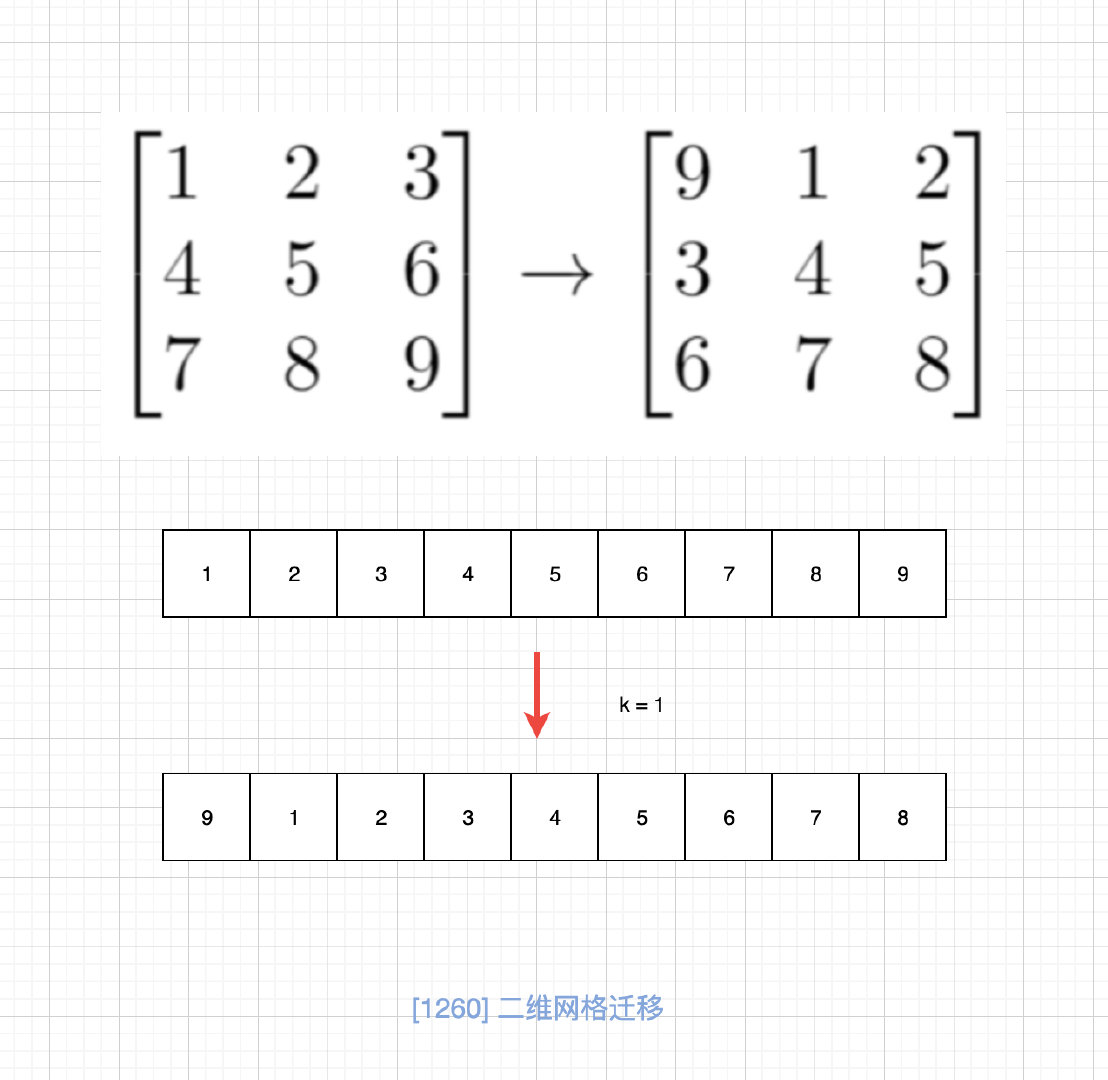
因此这个问题就转化为我们一直的一维矩阵转移问题,LeetCode 也有原题[189. 旋转数组](https://leetcode-cn.com/problems/rotate-array/),同时我也写了一篇文章[文科生都能看懂的循环移位算法](https://lucifer.ren/blog/2019/12/11/rotate-list/)专门讨论这个,最终我们使用的是三次旋转法,相关数学证明也有写,很详细,这里不再赘述。
LeetCode 真的是喜欢换汤不换药呀 😂
#### 代码
Python 代码:
```python
#
# @lc app=leetcode.cn id=1260 lang=python3
#
# [1260] 二维网格迁移
#
# @lc code=start
class Solution:
def shiftGrid(self, grid: List[List[int]], k: int) -> List[List[int]]:
n = len(grid)
m = len(grid[0])
# 二维到一维
arr = [grid[i][j] for i in range(n) for j in range(m)]
# 取模,缩小k的范围,避免无意义的运算
k %= m * n
res = []
# 首尾交换法
def reverse(l, r):
while l < r:
t = arr[l]
arr[l] = arr[r]
arr[r] = t
l += 1
r -= 1
# 三次旋转
reverse(0, m * n - k - 1)
reverse(m * n - k, m * n - 1)
reverse(0, m * n - 1)
# 一维到二维
row = []
for i in range(m * n):
if i > 0 and i % m == 0:
res.append(row)
row = []
row.append(arr[i])
res.append(row)
return res
# @lc code=end
```
**复杂度分析**
* 时间复杂度:$O(N)$
* 空间复杂度:$O(1)$
### 相关题目
* [189. 旋转数组](https://leetcode-cn.com/problems/rotate-array/)
### 参考
* [文科生都能看懂的循环移位算法](https://lucifer.ren/blog/2019/12/11/rotate-list/)
更多题解可以访问我的 LeetCode 题解仓库: 。 目前已经 37K star 啦。
关注公众号力扣加加,努力用清晰直白的语言还原解题思路,并且有大量图解,手把手教你识别套路,高效刷题。
