> For the complete documentation index, see [llms.txt](https://leetcode-solution-leetcode-pp.gitbook.io/leetcode-solution/llms.txt). Markdown versions of documentation pages are available by appending `.md` to page URLs; this page is available as [Markdown](https://leetcode-solution-leetcode-pp.gitbook.io/leetcode-solution/hard/1203.sort-items-by-groups-respecting-dependencies.md).
# 1203. 项目管理
### 题目地址(1203. 项目管理)
### 题目描述
```
公司共有 n 个项目和 m 个小组,每个项目要不无人接手,要不就由 m 个小组之一负责。
group[i] 表示第 i 个项目所属的小组,如果这个项目目前无人接手,那么 group[i] 就等于 -1。(项目和小组都是从零开始编号的)小组可能存在没有接手任何项目的情况。
请你帮忙按要求安排这些项目的进度,并返回排序后的项目列表:
同一小组的项目,排序后在列表中彼此相邻。
项目之间存在一定的依赖关系,我们用一个列表 beforeItems 来表示,其中 beforeItems[i] 表示在进行第 i 个项目前(位于第 i 个项目左侧)应该完成的所有项目。
如果存在多个解决方案,只需要返回其中任意一个即可。如果没有合适的解决方案,就请返回一个 空列表 。
示例 1:
```

```
输入:n = 8, m = 2, group = [-1,-1,1,0,0,1,0,-1], beforeItems = [[],[6],[5],[6],[3,6],[],[],[]]
输出:[6,3,4,1,5,2,0,7]
示例 2:
输入:n = 8, m = 2, group = [-1,-1,1,0,0,1,0,-1], beforeItems = [[],[6],[5],[6],[3],[],[4],[]]
输出:[]
解释:与示例 1 大致相同,但是在排序后的列表中,4 必须放在 6 的前面。
提示:
1 <= m <= n <= 3 * 104
group.length == beforeItems.length == n
-1 <= group[i] <= m - 1
0 <= beforeItems[i].length <= n - 1
0 <= beforeItems[i][j] <= n - 1
i != beforeItems[i][j]
beforeItems[i] 不含重复元素
```
### 前置知识
* 图论 - 拓扑排序
* BFS & DFS
### 公司
* 暂无
### 思路
首先这道题不简单。 题目隐藏了三个考点,参考了其他题解之后,发现他们思路挺不错的,但讲述的并不清楚,于是写下了这篇题解。
#### 考点一 - 如何确定拓扑排序?
对于拓扑排序,我们可以使用 BFS 和 DFS 两种方式来解决。
使用 BFS 则从入度为 0 的开始(没有任何依赖),将其邻居(依赖)逐步加入队列,并将入度(依赖数目)减去 1,如果减到 0 了,说明没啥依赖了,将其入队处理。这种做法不需要使用 visited 数组,因为环的入度不可能为 0,也就不会入队,自然不会有死循环。
代码:
```py
def tp_sort(self, items, indegree, neighbors):
q = collections.deque([])
ans = []
for item in items:
if not indegree[item]:
q.append(item)
while q:
cur = q.popleft()
ans.append(cur)
for neighbor in neighbors[cur]:
indegree[neighbor] -= 1
if not indegree[neighbor]:
q.append(neighbor)
return ans
```
使用 DFS 可以从图的任意一点出发,基于深度优先遍历检测是否有环。如果有,则返回 \[],如果没有,则直接将 path 返回即可。使用此方法需要 visited 数组。
代码:
```py
class Solution:
def tp_sort(self, items: int, pres: List[List[int]]) -> List[int]:
res = []
visited = [0] * items
adjacent = [[] for _ in range(items)]
def dfs(i):
if visited[i] == 1:
return False
if visited[i] == 2:
return True
visited[i] = 1
for j in adjacent[i]:
if not dfs(j):
return False
visited[i] = 2
res.append(i)
return True
for cur, pre in pres:
adjacent[cur].append(pre)
for i in range(items):
if not dfs(i):
return []
return res
```
相关题目:
* [210. 课程表 II](https://leetcode-cn.com/problems/course-schedule-ii/)
* [207. 课程表](https://leetcode-cn.com/problems/course-schedule/)
#### 考点二 - 如何确定项目的依赖关系?
如下图:
* 圆圈表示的是项目
* 黑色线条表示项目的依赖关系
* 红色线条表示项目和组之间的依赖关系
* 绿色线条是组之间的依赖关系
注意绿色线条不是题目给出的,而是需要我们自己生成。
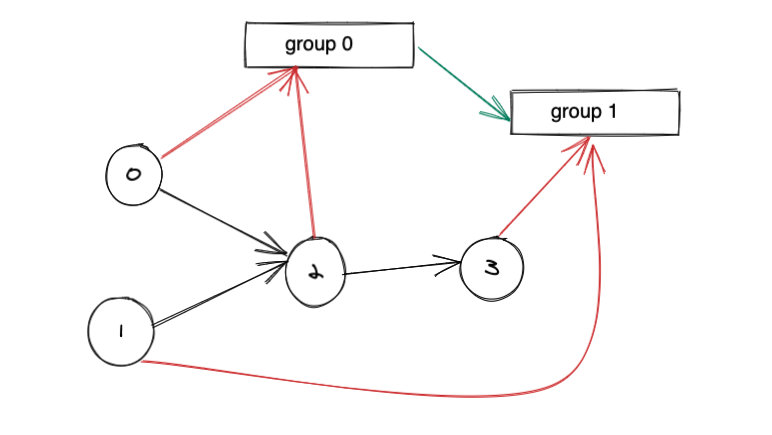
生成绿色部分依赖关系的核心逻辑是**如果一个项目和这个项目的依赖(如果存在)需要不同的组来完成**,那么这两个组就拥有依赖关系。代码:
```py
for pre in pres[project]:
if group[pre] != group[project]:
# 小组关系图
group_indegree[group[project]] += 1
group_neighbors[group[pre]].append(group[project])
else:
# 项目关系图
# ...
```
pres 是题目中的 beforeItems,即项目的依赖关系。
#### 考点三 - 无人负责的项目如何处理?
如果无组处理,意味着随便找一个组分配即可,这意味着其是图中入度为零的点。
一种方法是将这些无人处理的进行编号,只要给分别给它们一个不重复的 id 即可,注意这个 id 一定不能是已经存在的 id。由于原有的 group id 范围是 \[0, m-1] 因此我们可以从 m 开始并逐个自增 1 来实现,详见代码。

### 代码
代码支持:Python3
Python3:
```py
class Solution:
def tp_sort(self, items, indegree, neighbors):
q = collections.deque([])
ans = []
for item in items:
if not indegree[item]:
q.append(item)
while q:
cur = q.popleft()
ans.append(cur)
for neighbor in neighbors[cur]:
indegree[neighbor] -= 1
if not indegree[neighbor]:
q.append(neighbor)
return ans
def sortItems(self, n: int, m: int, group: List[int], pres: List[List[int]]) -> List[int]:
max_group_id = m
for project in range(n):
if group[project] == -1:
group[project] = max_group_id
max_group_id += 1
project_indegree = collections.defaultdict(int)
group_indegree = collections.defaultdict(int)
project_neighbors = collections.defaultdict(list)
group_neighbors = collections.defaultdict(list)
group_projects = collections.defaultdict(list)
for project in range(n):
group_projects[group[project]].append(project)
for pre in pres[project]:
if group[pre] != group[project]:
# 小组关系图
group_indegree[group[project]] += 1
group_neighbors[group[pre]].append(group[project])
else:
# 项目关系图
project_indegree[project] += 1
project_neighbors[pre].append(project)
ans = []
group_queue = self.tp_sort([i for i in range(max_group_id)], group_indegree, group_neighbors)
if len(group_queue) != max_group_id:
return []
for group_id in group_queue:
project_queue = self.tp_sort(group_projects[group_id], project_indegree, project_neighbors)
if len(project_queue) != len(group_projects[group_id]):
return []
ans += project_queue
return ans
```
**复杂度分析**
令 m 和 n 分别为图的边数和顶点数。
* 时间复杂度:$O(m + n)$
* 空间复杂度:$O(m + n)$
大家对此有何看法,欢迎给我留言,我有时间都会一一查看回答。更多算法套路可以访问我的 LeetCode 题解仓库: 。 目前已经 37K star 啦。 大家也可以关注我的公众号《力扣加加》带你啃下算法这块硬骨头。 