> For the complete documentation index, see [llms.txt](https://leetcode-solution-leetcode-pp.gitbook.io/leetcode-solution/llms.txt). Markdown versions of documentation pages are available by appending `.md` to page URLs; this page is available as [Markdown](https://leetcode-solution-leetcode-pp.gitbook.io/leetcode-solution/medium/62.unique-paths.md).
# 0062. 不同路径
### 题目地址(62. 不同路径)
### 题目描述
```
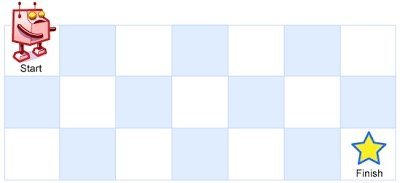
一个机器人位于一个 m x n 网格的左上角 (起始点在下图中标记为“Start” )。
机器人每次只能向下或者向右移动一步。机器人试图达到网格的右下角(在下图中标记为“Finish”)。
问总共有多少条不同的路径?
```
```
例如,上图是一个7 x 3 的网格。有多少可能的路径?
示例 1:
输入: m = 3, n = 2
输出: 3
解释:
从左上角开始,总共有 3 条路径可以到达右下角。
1. 向右 -> 向右 -> 向下
2. 向右 -> 向下 -> 向右
3. 向下 -> 向右 -> 向右
示例 2:
输入: m = 7, n = 3
输出: 28
提示:
1 <= m, n <= 100
题目数据保证答案小于等于 2 * 10 ^ 9
```
### 前置知识
* 排列组合
* [动态规划](/leetcode-solution/thinkings/dynamic-programming.md)
### 公司
* 阿里
* 腾讯
* 百度
* 字节
### 思路
首先这道题可以用排列组合的解法来解,需要一点高中的知识。

而这道题我们也可以用动态规划来解。其实这是一道典型的适合使用动态规划解决的题目,它和爬楼梯等都属于动态规划中最简单的题目,因此也经常会被用于面试之中。
读完题目你就能想到动态规划的话,建立模型并解决恐怕不是难事。其实我们很容易看出,由于机器人只能右移动和下移动, 因此第\[i, j]个格子的总数应该等于\[i - 1, j] + \[i, j -1], 因为第\[i,j]个格子一定是从左边或者上面移动过来的。

这不就是二维平面的爬楼梯么?和爬楼梯又有什么不同呢?
代码大概是:
Python Code:
```python
class Solution:
def uniquePaths(self, m: int, n: int) -> int:
d = [[1] * n for _ in range(m)]
for col in range(1, m):
for row in range(1, n):
d[col][row] = d[col - 1][row] + d[col][row - 1]
return d[m - 1][n - 1]
```
**复杂度分析**
* 时间复杂度:$O(M \* N)$
* 空间复杂度:$O(M \* N)$
由于 dp\[i]\[j] 只依赖于左边的元素和上面的元素,因此空间复杂度可以进一步优化, 优化到 O(n).

具体代码请查看代码区。
当然你也可以使用记忆化递归的方式来进行,由于递归深度的原因,性能比上面的方法差不少:
> 直接暴力递归的话可能会超时。
Python3 Code:
```python
class Solution:
@lru_cache
def uniquePaths(self, m: int, n: int) -> int:
if m == 1 or n == 1:
return 1
return self.uniquePaths(m - 1, n) + self.uniquePaths(m, n - 1)
```
### 关键点
* 排列组合原理
* 记忆化递归
* 基本动态规划问题
* 空间复杂度可以进一步优化到 O(n), 这会是一个考点
### 代码
代码支持 JavaScript,Python3, CPP
JavaScript Code:
```js
/*
* @lc app=leetcode id=62 lang=javascript
*
* [62] Unique Paths
*
* https://leetcode.com/problems/unique-paths/description/
*/
/**
* @param {number} m
* @param {number} n
* @return {number}
*/
var uniquePaths = function (m, n) {
const dp = Array(n).fill(1);
for (let i = 1; i < m; i++) {
for (let j = 1; j < n; j++) {
dp[j] = dp[j] + dp[j - 1];
}
}
return dp[n - 1];
};
```
Python3 Code:
```python
class Solution:
def uniquePaths(self, m: int, n: int) -> int:
dp = [1] * n
for _ in range(1, m):
for j in range(1, n):
dp[j] += dp[j - 1]
return dp[n - 1]
```
CPP Code:
```cpp
class Solution {
public:
int uniquePaths(int m, int n) {
vector dp(n + 1, 0);
dp[n - 1] = 1;
for (int i = m - 1; i >= 0; --i) {
for (int j = n - 1; j >= 0; --j) dp[j] += dp[j + 1];
}
return dp[0];
}
};
```
**复杂度分析**
* 时间复杂度:$O(M \* N)$
* 空间复杂度:$O(N)$
### 扩展
你可以做到比$O(M \* N)$更快,比$O(N)$更省内存的算法么?这里有一份[资料](https://leetcode.com/articles/unique-paths/)可供参考。
> 提示: 考虑数学
### 相关题目
* [70. 爬楼梯](https://leetcode-cn.com/problems/climbing-stairs/)
* [63. 不同路径 II](https://github.com/azl397985856/leetcode/blob/master/problems/63.unique-paths-ii.md)
* [【每日一题】- 2020-09-14 -小兔的棋盘](https://github.com/azl397985856/leetcode/issues/429)